Fox Hill Marketing Academy - Free Course
IN THIS LESSON
Reading Lesson
The Five-Point Visibility Check: A Deep Dive | Estimated reading time: 20 minutes
How to read this lesson:
Read through once without stopping. Then go back through with the workbook open beside you, and fill in your scores as you read each check. This sequence — reading first, scoring second — tends to produce more honest results than scoring on the fly.
Why Visibility Is the First Problem to Solve
Before any other piece of marketing can work, before you worry about your Instagram presence, your email list, your brand colors, or your content calendar, one thing has to be true: people who don't know you yet have to be able to find you.
This sounds obvious. But for most small businesses in NY and New England, salons, repair shops, farms, market vendors, pottery studios, artisan makers, independent cafés, specialty food producers, it isn't actually true. The business is there. The quality is there. The story is worth telling. But the door is invisible.
A customer in Smithtown searches 'farm stand open today,' and your farm doesn't come up. A visitor to coastal Maine asks Siri for 'pottery studio nearby' and your studio, the one that's been there for twelve years, doesn't appear. A woman in Providence tells her friend she's looking for a CSA, and the friend can't remember the name of the one she loves, because she never knew the name in the first place.
These are not marketing failures in the traditional sense. They're visibility failures. And they're entirely fixable, usually without spending any money, and usually in less than a day's worth of work spread over a few weeks.
The five-point visibility check is how you find out exactly where the gaps are. Let's go through each one properly.
Check 1: Your Google Presence
Google Business Profile is the most important piece of marketing infrastructure most small business owners have, and most of them haven't thought about it since they set it up three years ago.
Here's why it matters so much: when someone searches for what you sell in your area, Google shows them a map and a set of listings before it shows any websites. Those listings, called the Local Pack, are driven almost entirely by your Google Business Profile. If your profile is incomplete, inaccurate, or thin on photos, you either don't appear in the Local Pack or you appear lower than you should.
The difference between appearing third versus first in a local search result is roughly a 30% difference in clicks. And clicks from a local search are different from social media engagement — these are people with a specific need right now, ready to act.
What a strong Google Business Profile looks like
Photos come first, because Google weights them heavily in its ranking algorithm and because they're the first thing a prospective customer sees. You need at least ten photos. The most effective photos are: the exterior of your business (so customers can recognize it when they arrive), the interior or the setting (so they know what they're walking into), your products or produce (so they know what you actually sell), and ideally at least one photo showing a person, a vendor, a maker, a farmer, because people connect to people.
These don't need to be professional photographs. A well-lit phone photo taken on a clear day is better than a professional photo taken at dusk, because brightness reads as welcoming in a small thumbnail on a search results page.
Hours come next, and this is where the most damage happens. Wrong hours, or worse, hours listed as 'not available' are a significant trust problem. A customer who drives out to your farm stand and finds it closed when Google said it was open is not coming back. They may leave a review. At minimum, they've been trained not to trust you. Update your hours at the start of every season, every time your schedule changes, and mark special closures (holidays, slow weeks in January) when they happen.
Your business description is 750 characters of prime real estate that most businesses fill with something like 'we're a family-owned farm committed to sustainable agriculture.' That sentence is true, but it does almost no work. A stronger description answers: what exactly do you sell (be specific, weekly vegetable boxes, not 'fresh produce'), where you are, and how far people should be willing to drive, what makes you different from other options, and when you're available. It should also include the natural search terms people would use, 'farm stand,' 'CSA,' 'u-pick,' 'farmers market, not crammed in awkwardly, but woven naturally into the description.
Reviews are covered in Check 4. But from a Google profile standpoint: respond to every review. A business that responds to reviews is a business that's paying attention, and Google notices this as a signal of an active, legitimate listing.
Check 2: Your Website's First Impression
The six-second rule is not a marketing cliché; it's backed by a consistent pattern across thousands of website analytics. The average visitor to a local business website decides whether to stay or leave within six seconds of arriving. And that decision is almost entirely based on one thing: can they tell, immediately, whether this website is for them?
That means your homepage, specifically, what appears above the fold (before any scrolling) on a mobile phone, needs to answer three questions in six seconds or fewer. What do you sell? Where are you? Why should I choose you over the next result?
The most common way homepages fail this test is the 'beautiful but silent' problem. A large, moody photo of a field at sunrise. A tagline like 'From our family to yours.' A navigation bar. Nothing that tells me what I'm actually looking at.
The fix is rarely a redesign
In the vast majority of cases, a homepage that fails the six-second test doesn't need to be rebuilt; it needs to be edited. The simplest version of the fix is this: make the first line of readable text on your homepage a plain-English sentence describing what you do and where you are.
'We're a certified organic farm stand in Woodstock, Vermont, open May through October, with weekly vegetable boxes available for pickup or delivery within 20 miles.'
That one sentence answers all three questions. It tells someone what you sell (certified organic produce and weekly boxes), where you are (Woodstock, Vermont), and implies why to choose you (certified organic, specific delivery radius). It took about thirty seconds to write, and it will do more work than any logo redesign.
The second most common homepage failure is the missing call to action. What do you want a visitor to do? Visit your farm stand? Sign up for a CSA? Come to your studio? Book an appointment? There should be one clear action, stated plainly, visible without scrolling. Not four Calls to Action, one. The paradox of choice is real: when visitors see multiple equally-weighted options, they often choose none of them.
The mobile test
Pull up your website on your phone, not on a computer. This is how the majority of your visitors are seeing it, especially people who found you in a local search. Does it load in under three seconds? Does the text scale correctly, or does it look crammed? Can you tap the phone number to call? Is the address clickable to open in Maps?
A website that looks great on a desktop and broken on a phone is losing you customers, every week. Squarespace and most modern website platforms handle mobile responsiveness automatically, but it's worth testing personally rather than assuming.
Check 3: Your Directory Presence
Google is not the only place people look for local businesses. Apple Maps is the default navigation app on every iPhone, which means every Siri search, every 'get directions' tap, every 'find a farm near me' on an iPhone pulls from Apple Maps, not Google. If your Apple Maps listing is unclaimed, incomplete, or missing entirely, you're invisible to half your potential customers before you even begin.
Yelp remains important for food, hospitality, and experience businesses, such as cafés, farm-to-table restaurants, tasting rooms, and pick-your-own orchards. Bing Places powers the default search on Microsoft Edge and feeds results to Amazon Alexa. TripAdvisor matters for anything tourism-adjacent. And for agricultural businesses in New England specifically, there's a whole ecosystem of regional directories — MOFGA in Maine, Vermont Fresh Network, NOFA chapters across the region, LocalHarvest, the Edible publication directories that carry real trust with the kind of customers who seek out local and independent businesses.
NAP (Name, Address, Phone) consistency: the invisible ranking factor
Beyond just being listed, there's a technical factor that surprises most business owners: Google uses the consistency of your name, address, and phone number across the internet as a signal to verify that your business is real and your information is accurate. When Google sees your address listed slightly differently in different places — a missing suite number, a slightly different street name, an old phone number- it interprets that inconsistency as a signal of lower reliability.
This is called NAP consistency (Name, Address, Phone), and it's one of the easiest local SEO factors to fix and one of the most commonly neglected. The goal is simple: pick one version of your business name, one version of your address, one phone number — and make sure that exact version appears everywhere.
The workbook includes a directory checklist. Go through it. Check each one. The whole exercise takes about ninety minutes, and it's a one-time fix that pays dividends for years.
Check 4: Your Review Footprint
Reviews are the most powerful trust signal a local business has. They're more trusted than any marketing copy you write, any photo you post, any ad you run. A stranger's honest account of their experience with your business carries more weight than anything you say about yourself.
But most small business owners treat reviews as something that happens to them, rather than something they actively manage. The result is usually a review profile that's thinner, older, and less representative of the actual customer experience than it should be.
The ask is the whole game
The number one factor in whether a satisfied customer leaves a review is whether someone asked them to. Not via an automated email two days later. Not via a sign on the counter. In person. At the moment of a great experience.
'We'd really appreciate a Google review if you have a minute, it makes a big difference for a small business like ours.' Said face-to-face, at the farmers market, at pickup, at the end of a tour. That sentence, asked genuinely and consistently, will build a review profile faster than any software or any strategy.
The reason it works is psychological: when someone has just had a positive experience and feels good about your business, the motivation to leave a review is at its peak. That motivation decays quickly; by the time they're home, they've thought of three other things to do. You have a small window, and asking in the moment captures it.
Responding to reviews — including the difficult ones
Every review deserves a response. Responding to positive reviews is easy and builds goodwill. Responding to negative reviews is harder but arguably more important.
When someone leaves a critical review, your response is not really for them — it's for every future customer who reads that exchange and decides whether they trust you. A business that ignores negative reviews looks defensive and disengaged. A business that responds calmly, acknowledges the concern, and explains what they'd do differently looks like a business that takes quality seriously.
Keep responses short. One sentence of acknowledgment, one sentence of response. Don't get into specifics of the dispute. Don't explain at length. Don't argue. Thank them for the feedback and move on. The goal is to demonstrate character, not to win.
Recency matters more than volume
A business with 60 reviews, the most recent from two years ago, raises a question: are they still open? Are they still good? Recency signals that a business is active, that people are still visiting, and that the quality has been maintained. Aim to consistently add fresh reviews across the year, not just in a surge when you first think about it.
Check 5: Word of Mouth Readiness
This is the check that's hardest to score and easiest to overlook because it isn't digital, it isn't tracked, and it doesn't show up in any analytics dashboard. But it may be the most important one.
Word of mouth is the highest-conversion marketing channel available to a local business. A recommendation from a trusted friend or colleague converts at a rate that no paid ad can approach — sometimes cited as twenty times the conversion rate of a cold digital impression. If your business is good and you serve your customers well, word of mouth will happen. The question is whether it's happening efficiently.
The Dinner Test
Here's the exercise. Imagine your three best customers, the ones who love what you do and would happily recommend you. Each of them is at dinner with a friend who mentions they're looking for exactly what you offer. In a single sentence, what would those customers say?
Most business owners, when they think about this honestly, realize that their customers would say something vague and general. 'Oh, there's this great farm stand near us.' 'There's a woman who does beautiful pottery.' 'I know a place.' These are warm, but they're not converting. The friend smiles, says 'oh nice,' and the conversation moves on.
Compare that to: 'There's a farm in Hadley that does a weekly box — twenty-five dollars, pickup on Fridays, everything is certified organic, and they grow twelve varieties of heirloom tomatoes. The sign-up is online.' That sentence converts. The friend goes home and looks it up.
The difference between those two descriptions is positioning — the specific, memorable, differentiated description of exactly who you are and what makes you worth going to. And positioning isn't something your customers develop on their own. It comes from what you tell them, what you write on your website, what you put on your signs, and how you describe yourself at the farmers market.
Building your positioning sentence
A positioning sentence has four parts: what you offer (specific), who it's for (not everyone), what makes it different (your one true thing), and where/when to get it. You don't have to hit all four every time, but the closer you get, the more 'spreadable' your business becomes.
Draft a version of it now. Then test it: read it to someone who doesn't know your business. Ask them what they'd tell a friend about you. If their version matches yours, your positioning is working. If it doesn't, you know what to refine.
Once you have a clear positioning sentence, put it everywhere: the first line of your Google description, the headline of your website, the label you use at markets, and the way you answer 'what do you do?' at every conversation. Repetition is how a business becomes describable, and describable businesses spread
Pulling It Together: How the Five Checks Connect
Each of the five checks works independently, but they compound when they work together. A great Google profile drives discovery. A clear website converts the discovery into action. Directory consistency reinforces the Google profile. Strong reviews build trust at every touchpoint. And good positioning makes every channel work better, your Google description is easier to write, your website headline is clearer, and your customers know what to say.
This is why the visibility check is the right place to start. It reveals where the compound system is broken — and once you fix the weakest point, the ripple effect improves everything downstream.
The workbook is next. Score yourself honestly. The gap between where you are and where you want to be is almost always smaller than it feels from the inside. Usually, it's a few specific fixes, a few hours of focused attention, and one consistent new habit.
That's the work. Let's go find out exactly where you are.

Ready to keep going?
Don’t Stop Now!
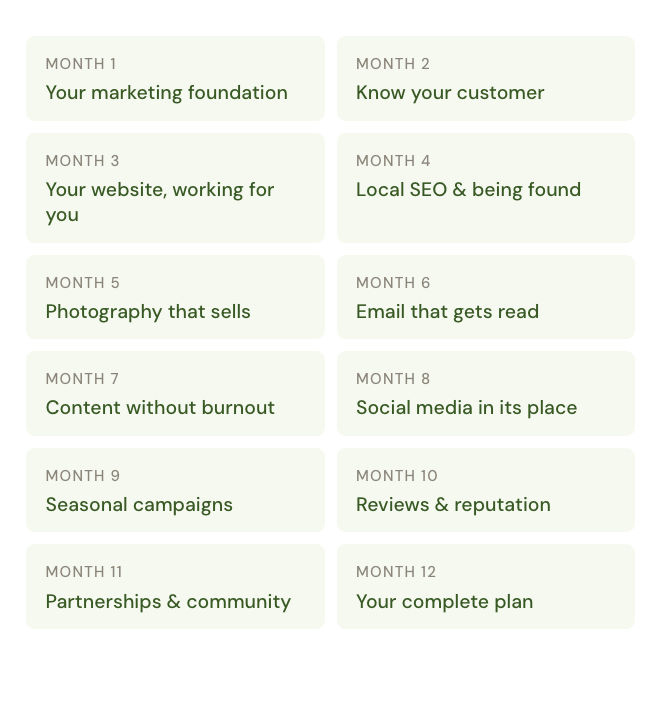
The full curriculum goes
twelve months deep.
This lesson is a taste of what Fox Hill Marketing Academy delivers every month: video, reading, podcast, and a workbook, built for the pace of a working New England business.
Each month builds on the last, until by Month 12 you have a complete marketing system. Not a collection of tips. A system.